
The 12 Most Popular Aerobatic Figures, Explained (and How to Watch Them in 3D)
Aerobatics is the art of flying an aircraft through precise, deliberate paths in three-dimensional space. It is not random maneuvering or showing off: every figure has a defined geometry, an entry attitude, a sequence of control inputs, and an exit that must match the judge's or the spectator's expectation. The same handful of figures appears again and again, from a first loop lesson to a world championship Free Unknown.
These twelve figures are the vocabulary of every airshow and competition sequence. Learn to recognize them and the sky stops being a blur of spinning airplanes and becomes a readable story. Each one below is paired with an interactive 3D animation on Aerobatics Atlas, so you can pause, orbit the model, and see exactly what the aircraft is doing.
Inside loop
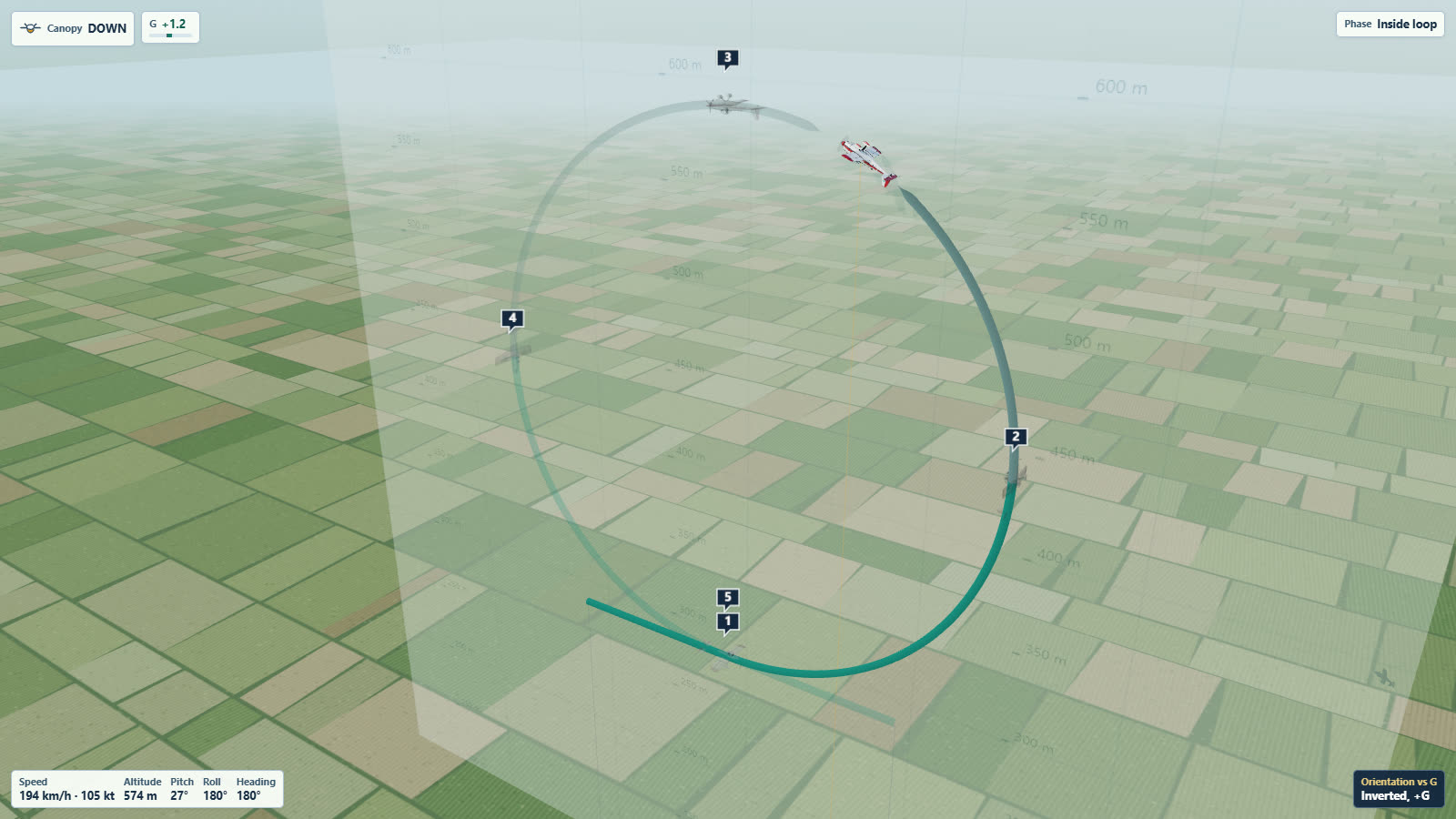
The inside loop is a complete 360-degree loop in the vertical plane. The aircraft is inverted at the highest point, but the inside curvature is still produced by positive G throughout. It is the foundational figure of aerobatics: almost everything else is built from pieces of it.
Flown from level flight, the pilot pulls smoothly and progressively, keeping the loop round and in one vertical plane. The pull continues through the inverted top, where the pilot feels positive G pressing them into the seat even though the canopy faces the ground, and eases off as the aircraft returns to level flight on the same heading.
What to look for: check the top. The nose points back toward the entry direction, and the canopy and pilot face toward the ground. If the loop looks egg-shaped or drifts sideways, the geometry is off.
You see it in primary training, in every competition programme, and at essentially every airshow.
Watch the Inside loop in 3DAileron roll
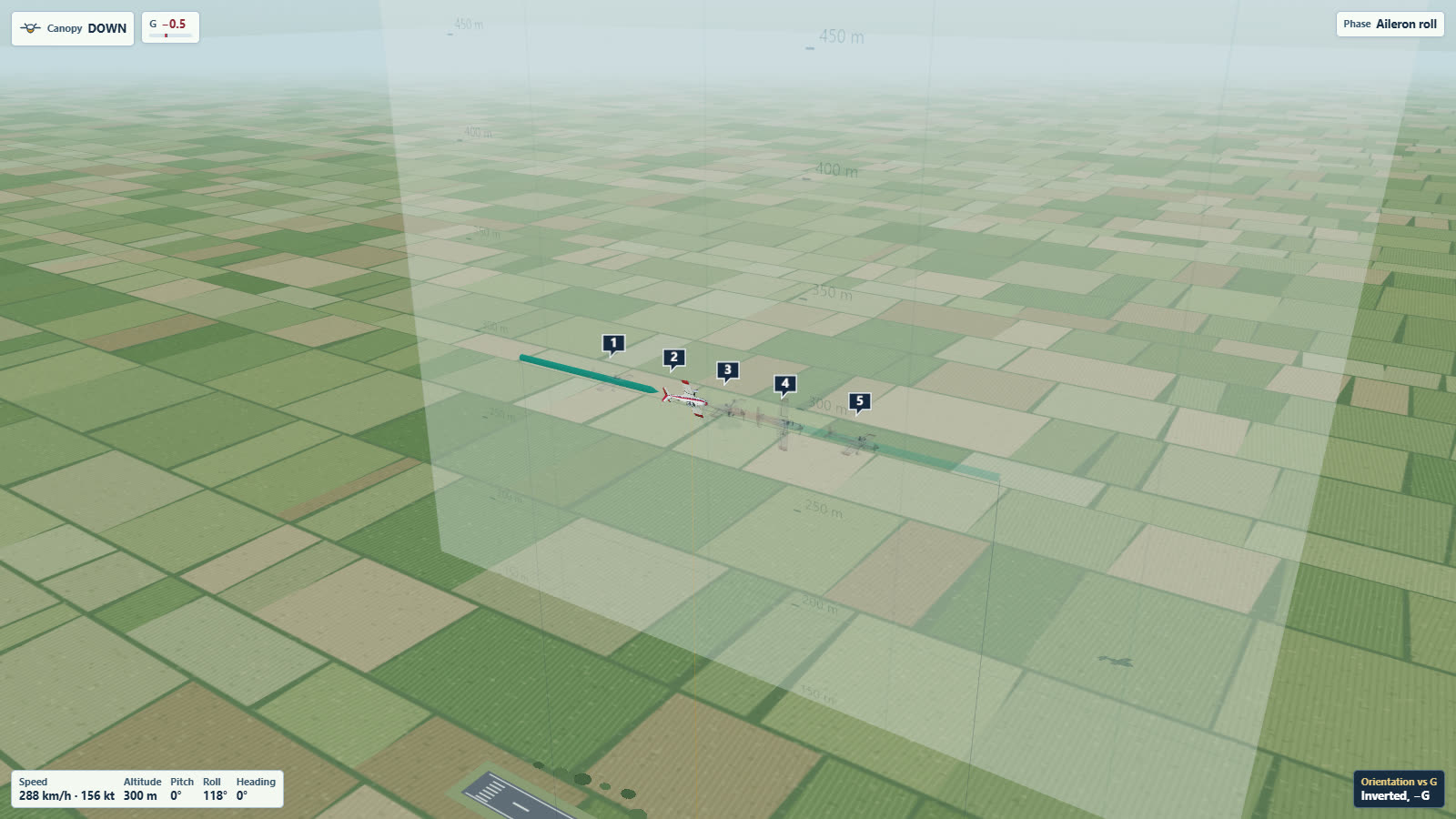
An aileron roll is a 360-degree rotation about the aircraft's longitudinal axis. The aircraft continues along a generally straight track rather than tracing a barrel. It looks simple from the ground and is surprisingly demanding to do cleanly.
The pilot raises the nose a little above the horizon, then applies aileron and lets the aircraft roll at a steady rate through knife-edge and inverted and back to upright, with little else on the controls. The load stays mostly positive and goes light as the aircraft passes inverted, which is why the nose drops a little by the end. A good one ends on the entry heading without a turn.
What to look for: think roll axis. The belly and canopy rotate around the nose-to-tail line, and the flight path stays straight. If the nose traces a circle in the sky, you are watching something else.
It appears in training syllabi, in competition sequences as a building block, and constantly at airshows. It is not the same as a barrel roll or a snap roll.
Watch the Aileron roll in 3DSlow roll
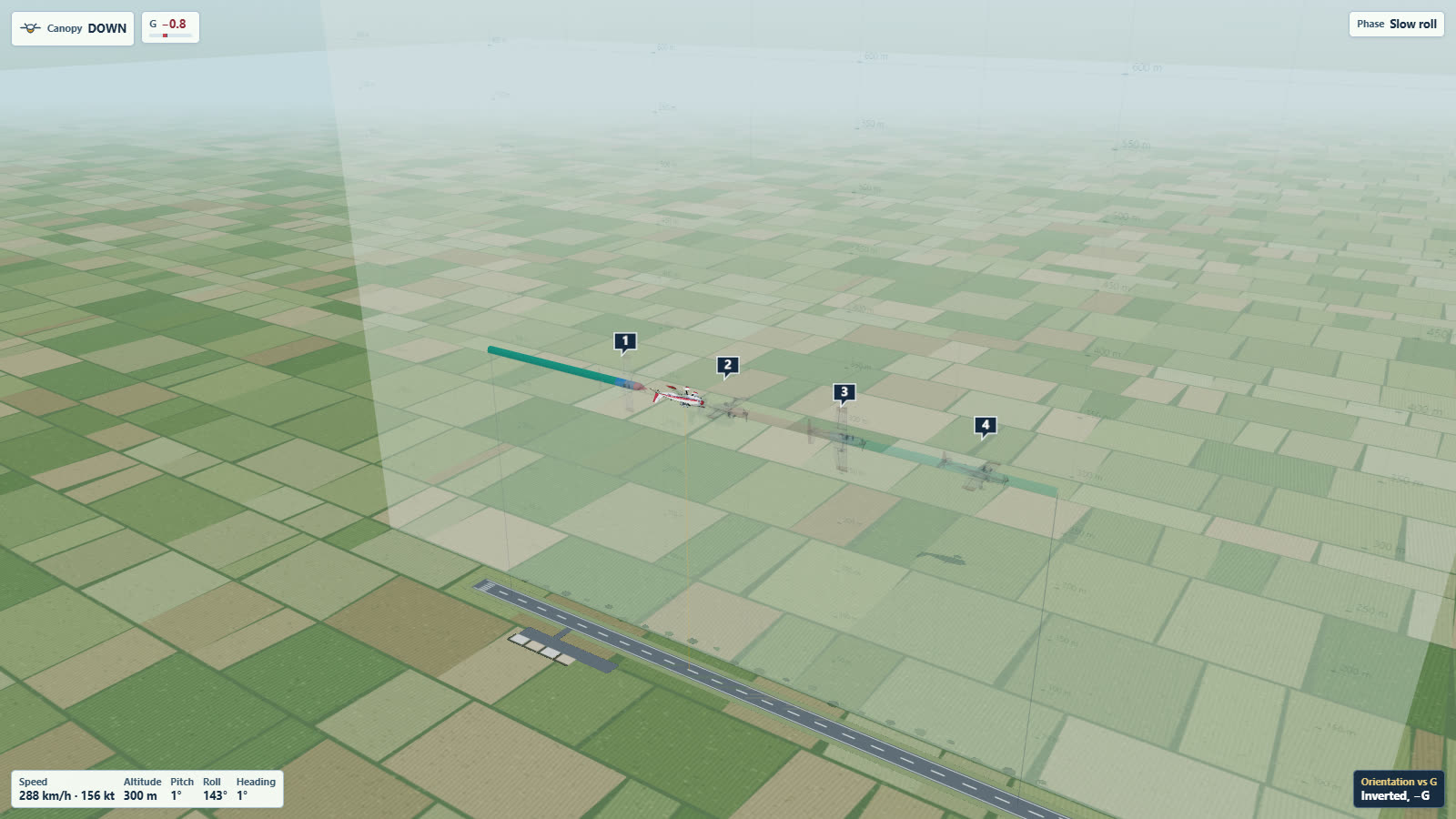
A slow roll is a smooth, constant-rate 360-degree roll on a straight line. Maintaining that line through upright, knife-edge, and inverted attitudes requires precise coordination of aileron, rudder, and elevator, which is why it is considered a precision figure rather than a basic one.
The pilot rolls slowly and continuously, feeding in rudder to counter adverse yaw and slip, and adjusting elevator as the lift vector rotates. Loads may change sign during the roll, so the pilot feels positive G upright, almost no vertical load on the knife-edge, and a push of about one negative G when inverted, hanging in the straps.
What to look for: halfway through, at 180 degrees of roll, the aircraft is inverted on the same straight line. It never arcs over the top the way a loop does.
You see it in competition sequences and in advanced training.
Watch the Slow roll in 3DFour-point roll
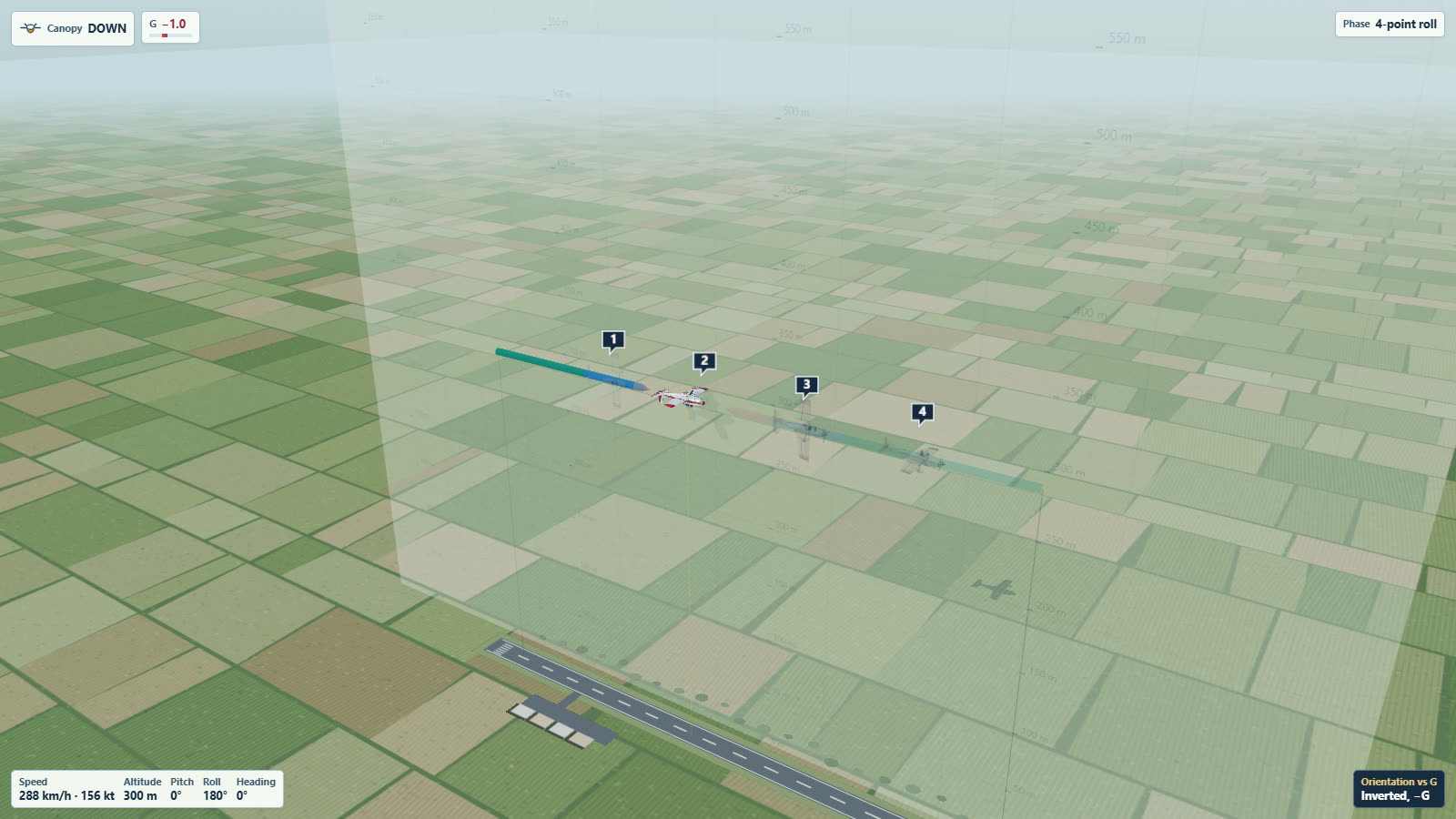
A four-point roll is an axial roll split into four 90-degree segments, briefly stopping at each knife-edge and inverted station. The pauses are the point: they expose any error in line, rate, or attitude that a continuous roll would hide.
The pilot rolls 90 degrees, stops, holds the knife-edge attitude with rudder, then rolls another 90 degrees to inverted, stops again, and continues through the second knife-edge back to upright. Each stop must be crisp and each segment equal. The pilot feels about one positive G upright, almost no vertical load at the two knife-edge points, and about one negative G at the inverted point.
What to look for: the 180-degree station is inverted, and the aircraft does not turn through a vertical loop. The nose should stay on the same line throughout.
It is a competition staple and a common training exercise for roll precision. Similar families include two-point and eight-point rolls.
Watch the Four-point roll in 3DBarrel roll
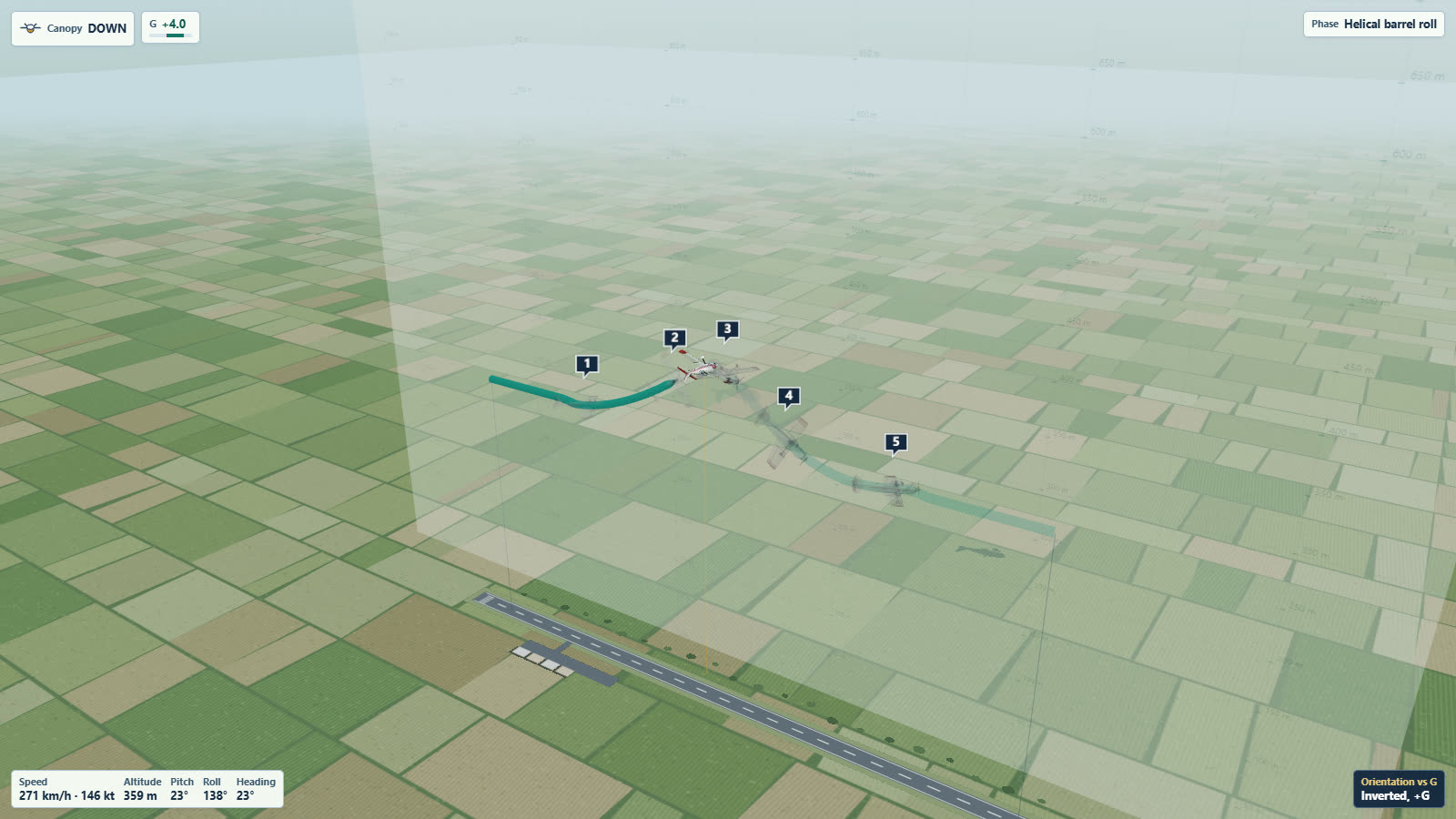
A barrel roll is a simultaneous looping and rolling motion around an imaginary cylinder. It is a corkscrew-shaped 3D path, not a flat roll, and that distinction is the whole figure.
The pilot begins a gentle pull while rolling, so the aircraft traces a helical path around a central axis, passing through inverted at the top of the barrel while the pilot remains under positive G. The nose describes a small circle in the sky rather than staying on a line. The path, roll rate, and height vary with technique; any diagram is a projection of a genuinely three-dimensional maneuver.
What to look for: at the upper part of the barrel, the airplane can be inverted while the pilot remains under positive G. That combination, inverted but still pressed into the seat, is the signature of a barrel roll.
You see it at airshows constantly and in competition sequences.
Watch the Barrel roll in 3DHammerhead (stall turn)
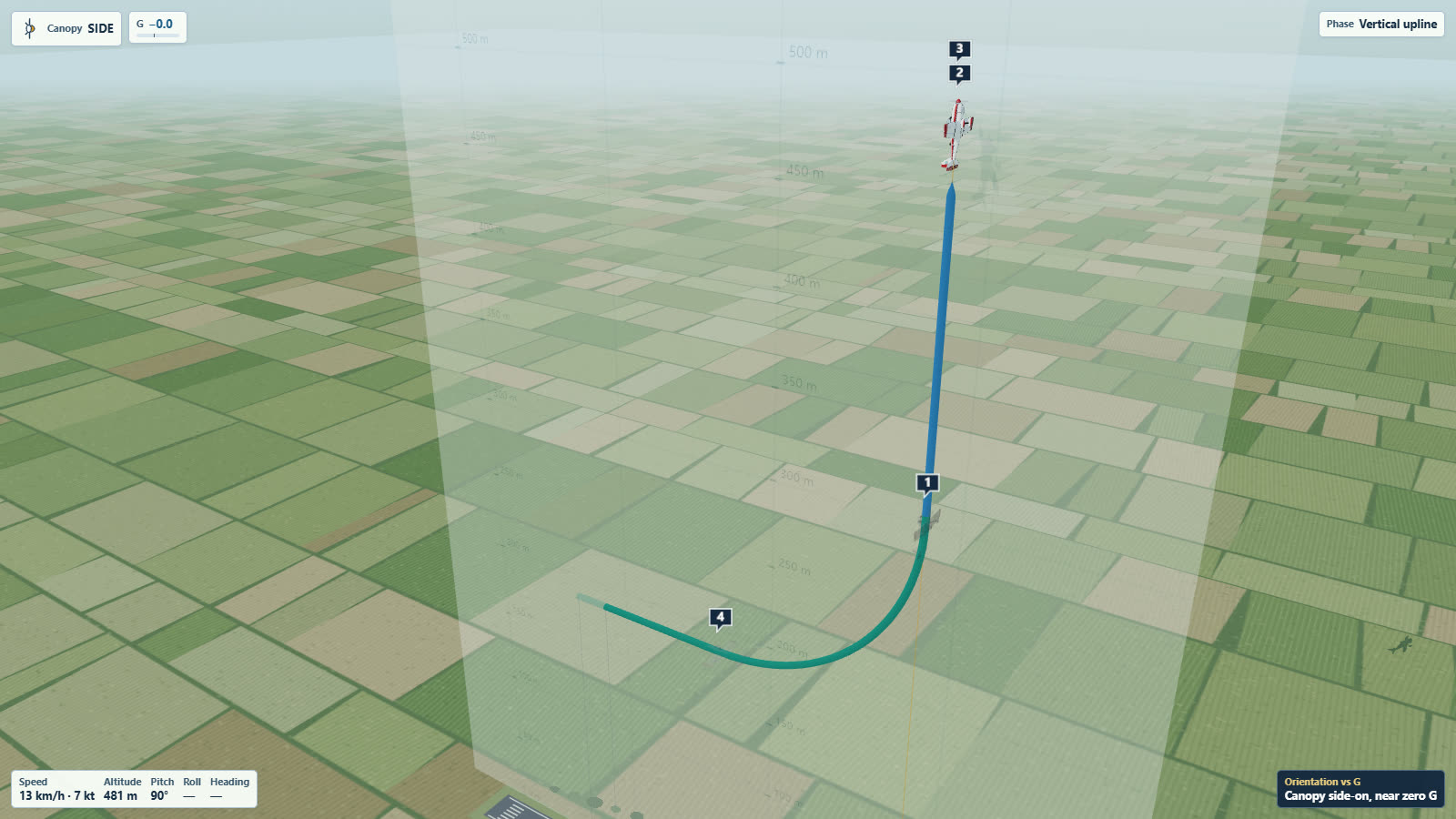
A hammerhead, or stall turn, is a quarter-loop into a vertical climb, a rudder-driven yaw pivot through 180 degrees at the top, then a vertical downline and a quarter-loop out. It converts airspeed into altitude, reverses direction, and returns on a parallel line.
The pilot pulls into the vertical, holds the climb until the speed decays, then applies rudder to yaw the nose through 180 degrees as the aircraft pivots around its own wingtip. The aircraft then accelerates down the vertical line before pulling out. G is positive in the entry and exit pulls, near zero at the pivot, and the pilot feels the aircraft go light and quiet at the top.
What to look for: the top is a yaw turn, not a rounded half-loop. The aircraft never goes inverted; it stays vertical and swings around.
It is a competition classic and an airshow favorite. The very low speed at the pivot and the engine's torque make the timing critical, so it is learned with an instructor.
Watch the Hammerhead (stall turn) in 3DTailslide
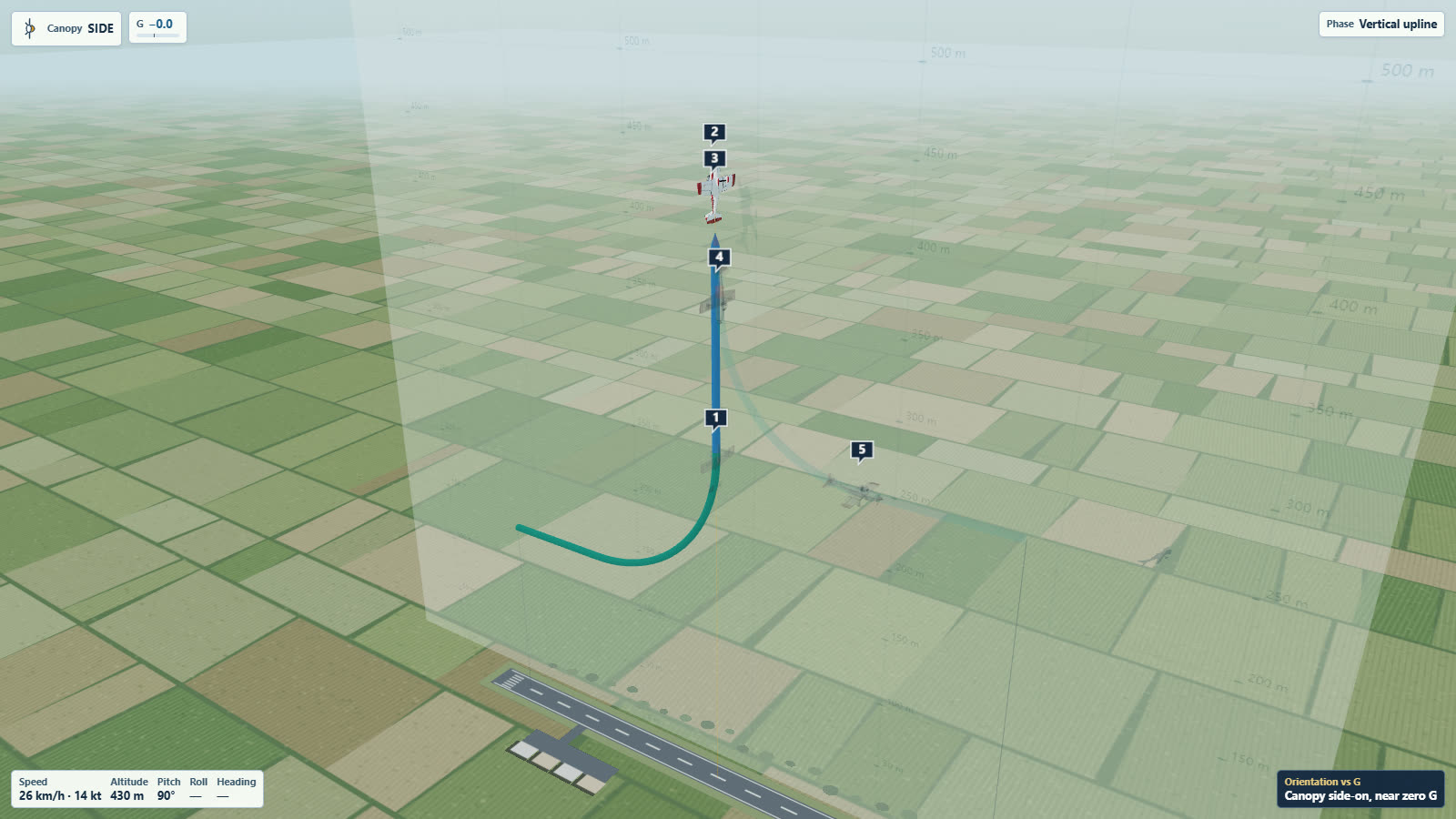
A tailslide is the aircraft climbing vertically until upward motion stops, sliding backward, and then tipping into nose-down flight before recovery. It is one of the few figures where the aircraft genuinely travels backwards.
The pilot establishes a vertical climb with enough energy to coast upward, holds the attitude as speed decays to zero, and then manages the moment when the aircraft begins to slide tail-first. The nose then falls through to the vertical downline and the pilot recovers. G is positive on the way up, near zero at the transition, and positive again in the recovery pull.
What to look for: neither a hammerhead nor a Humpty. The defining feature is actual rearward movement before the nose falls through.
It is an advanced figure that not every aerobatic type is cleared for, seen in competition and advanced training.
Watch the Tailslide in 3DImmelmann turn
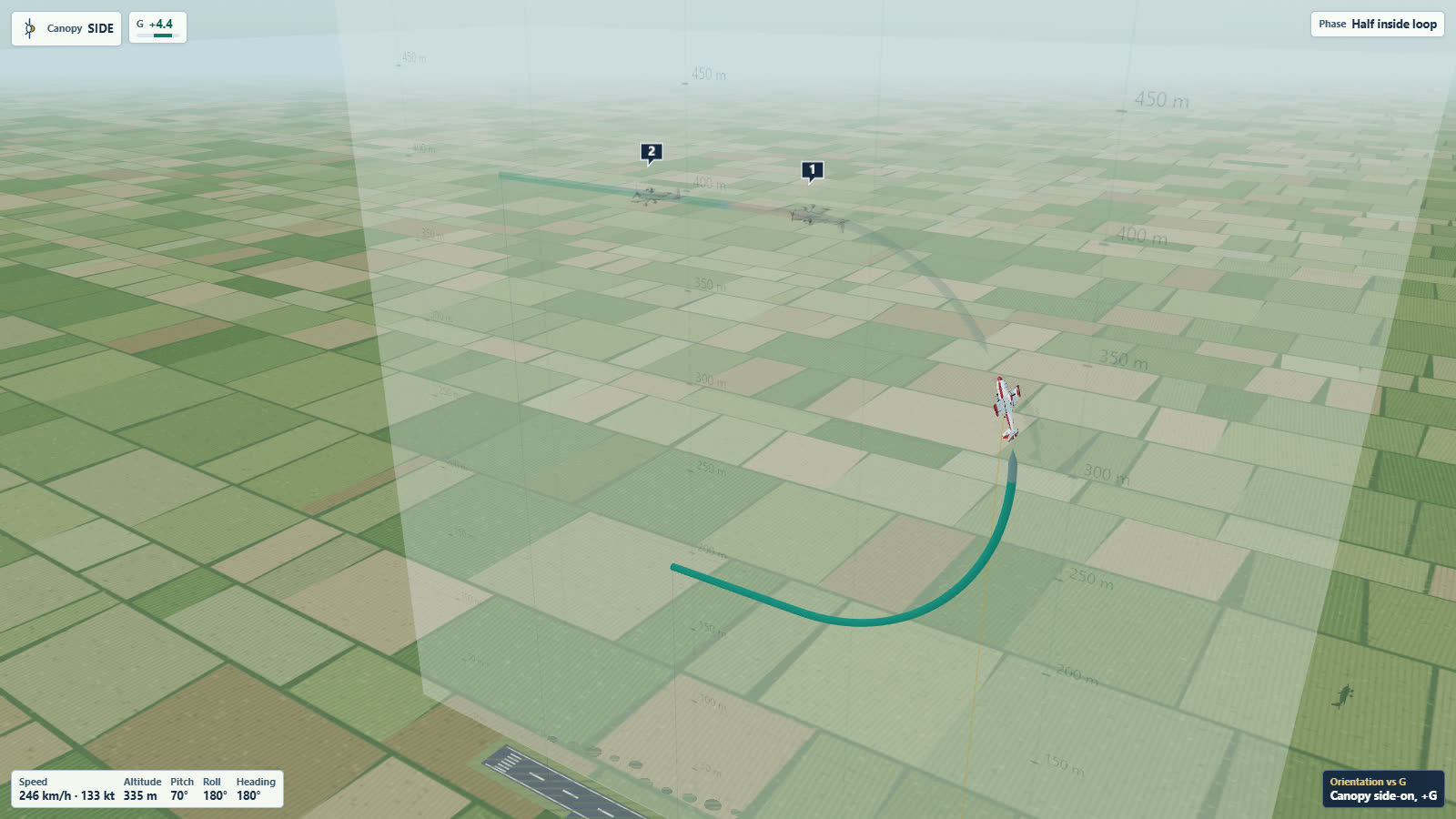
The Immelmann turn is a climb through an inside half-loop; at the top the aircraft is inverted and heading the opposite way, then a half roll restores upright flight. It trades airspeed for altitude and reverses heading in one smooth package.
The pilot pulls into a half-loop, holding positive G through the inverted top, then rolls upright as the aircraft comes over the top. The pilot feels sustained positive G through the loop portion, easing as the roll completes. The exit is upright, at a higher altitude, heading the opposite direction.
What to look for: at the high point before the roll, the airplane is inverted and the loop curvature is positive-G. If the aircraft rolls first and then loops, you are looking at a different figure.
It appears in competition sequences, in training for energy management, and at airshows.
Watch the Immelmann turn in 3DSplit-S
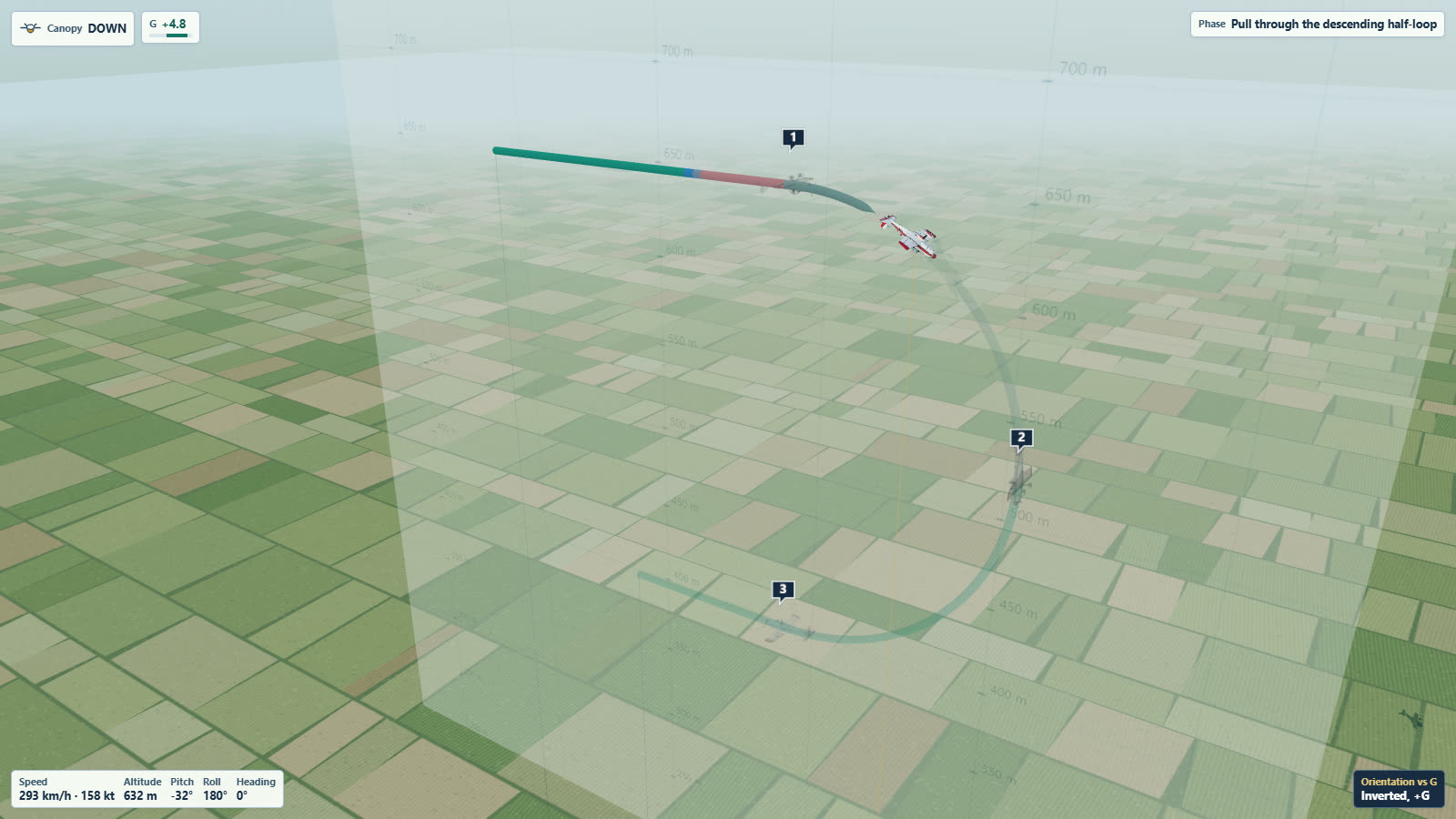
The Split-S begins from level flight: a 180-degree axial roll places the aircraft inverted, then a descending positive-G inside half-loop reverses heading. It trades altitude for airspeed, the mirror image of the Immelmann's trade.
The pilot rolls inverted, then pulls through the descending half-loop, holding positive G all the way, and finishes upright, lower and faster, on the opposite heading. The pilot feels positive G in the pull even though the entry was inverted, which is the counterintuitive part for new students.
What to look for: the descending arc is a pull even though the entry is inverted. The aircraft should not push through the maneuver.
It is a competition figure and a standard energy-management lesson. Height margins are central, so it is taught with careful altitude planning.
Watch the Split-S in 3DCuban Eight
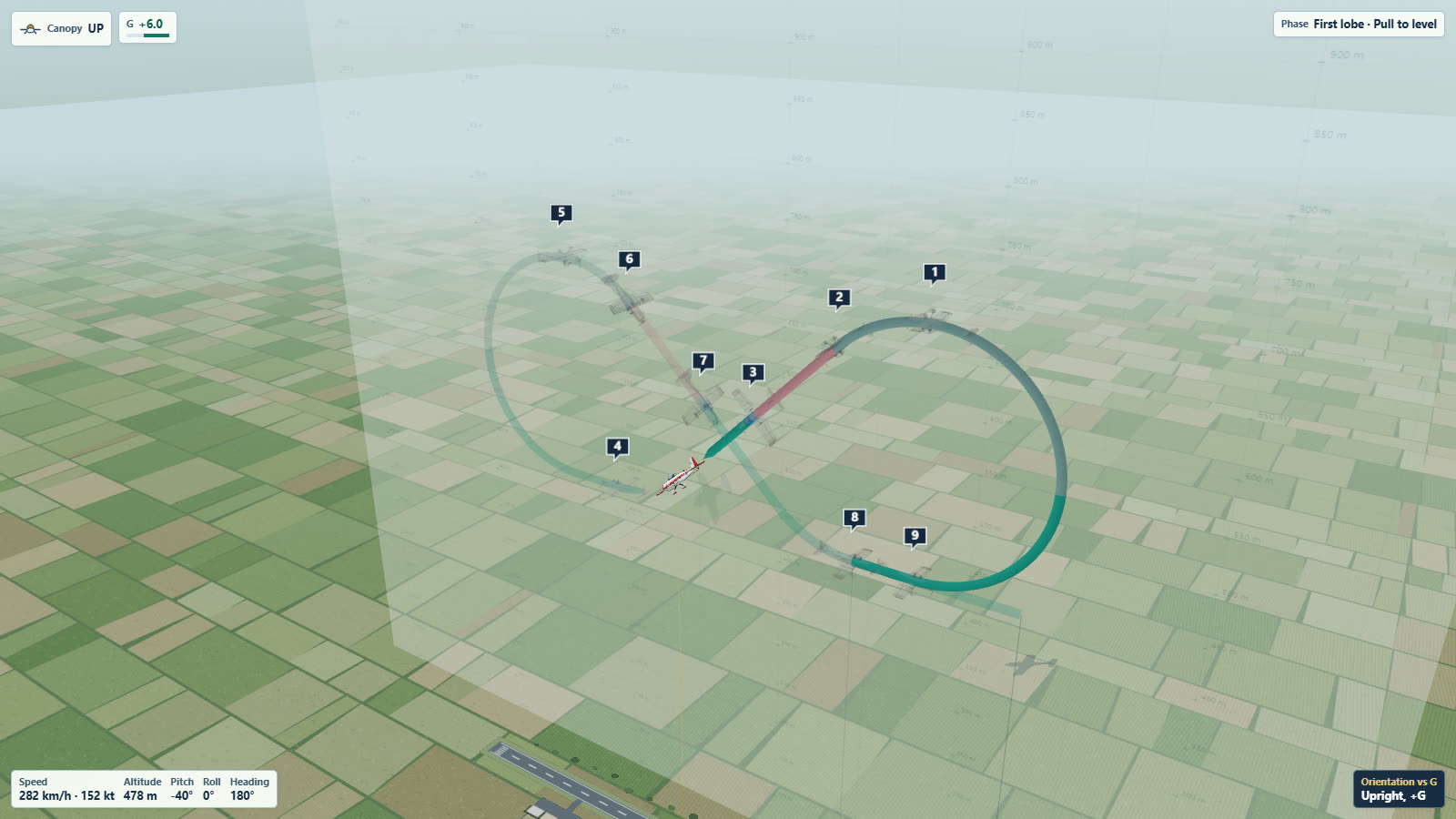
The Cuban Eight is two connected Half Cuban Eight figures, creating a horizontal figure-of-eight with two curved sections and axial half rolls on straight lines. It is one of the most recognizable competition figures and a beautiful thing to watch from the ground.
The pilot pulls through five-eighths of a loop, establishes a 45-degree downline, half-rolls upright, and pulls through the second five-eighths loop to repeat the pattern mirrored. G is positive through the loop portions and near one on the downlines and rolls.
What to look for: do not mistake the roll markers for pitch movements. The rolls happen on the straight 45-degree lines, not at the tops of the loops.
It is a competition staple and an airshow favorite, and it is much easier to follow in 3D than on a flat diagram.
Watch the Cuban Eight in 3DUpright spin
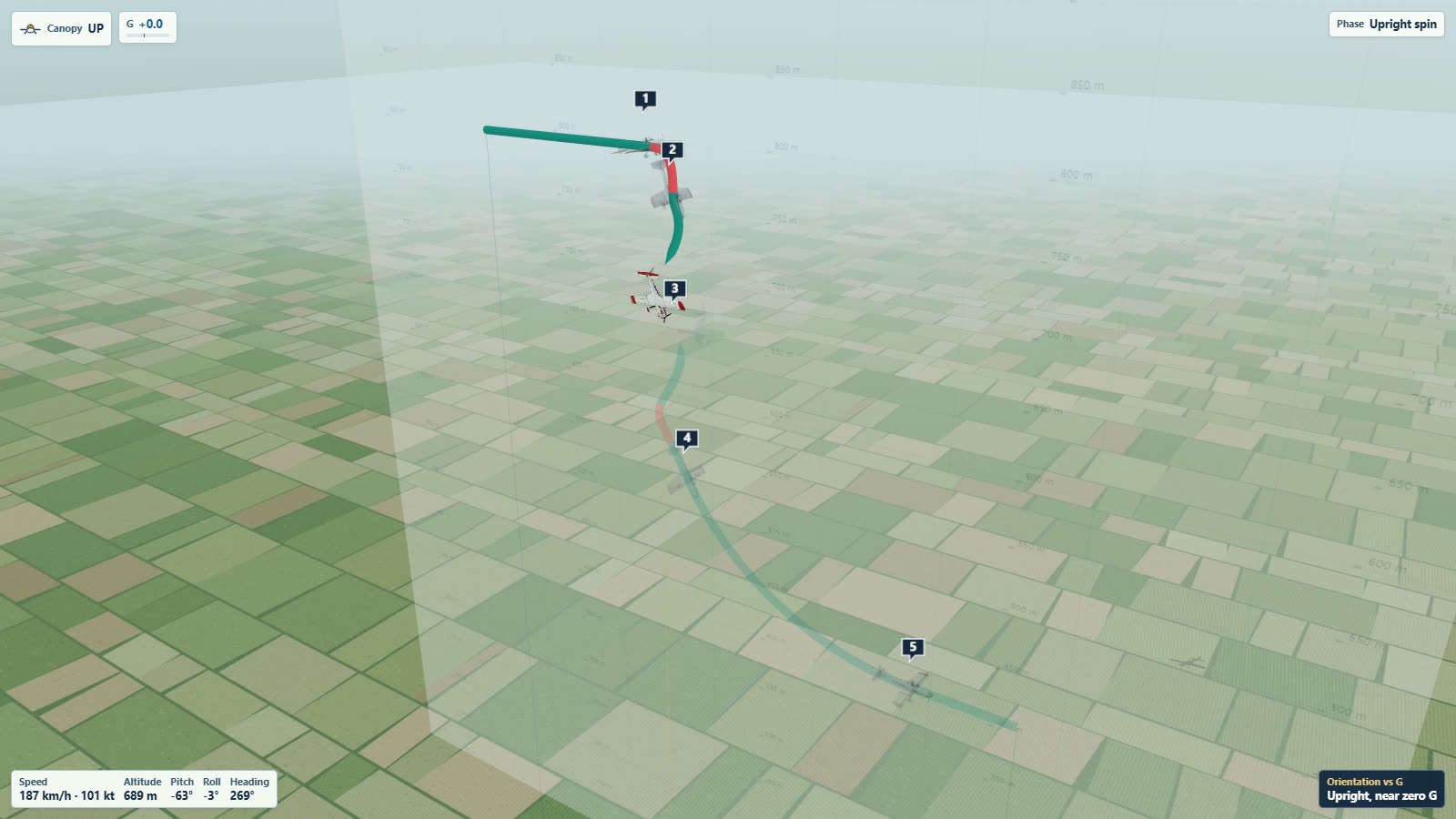
An upright spin is a developed spin entered from upright stalled flight. The aircraft follows a descending helical path while autorotating, and it is a genuine stalled condition rather than a controlled roll.
The pilot slows the aircraft to the stall and applies full rudder in the direction of the spin; one wing stalls more deeply than the other and the aircraft autorotates. Recovery follows PARE: power idle, ailerons neutral, opposite rudder, elevator forward until rotation stops, then a smooth pull to level flight. G is near one in the spin and positive in the recovery pull.
What to look for: spin rotation is not a controlled aileron roll. The aircraft is stalled, the nose is low, and the rotation continues without aileron input.
It is a training essential and appears in competition sequences. Learn type-specific entry and recovery directly from an instructor and the approved POH.
Watch the Upright spin in 3DInside snap roll
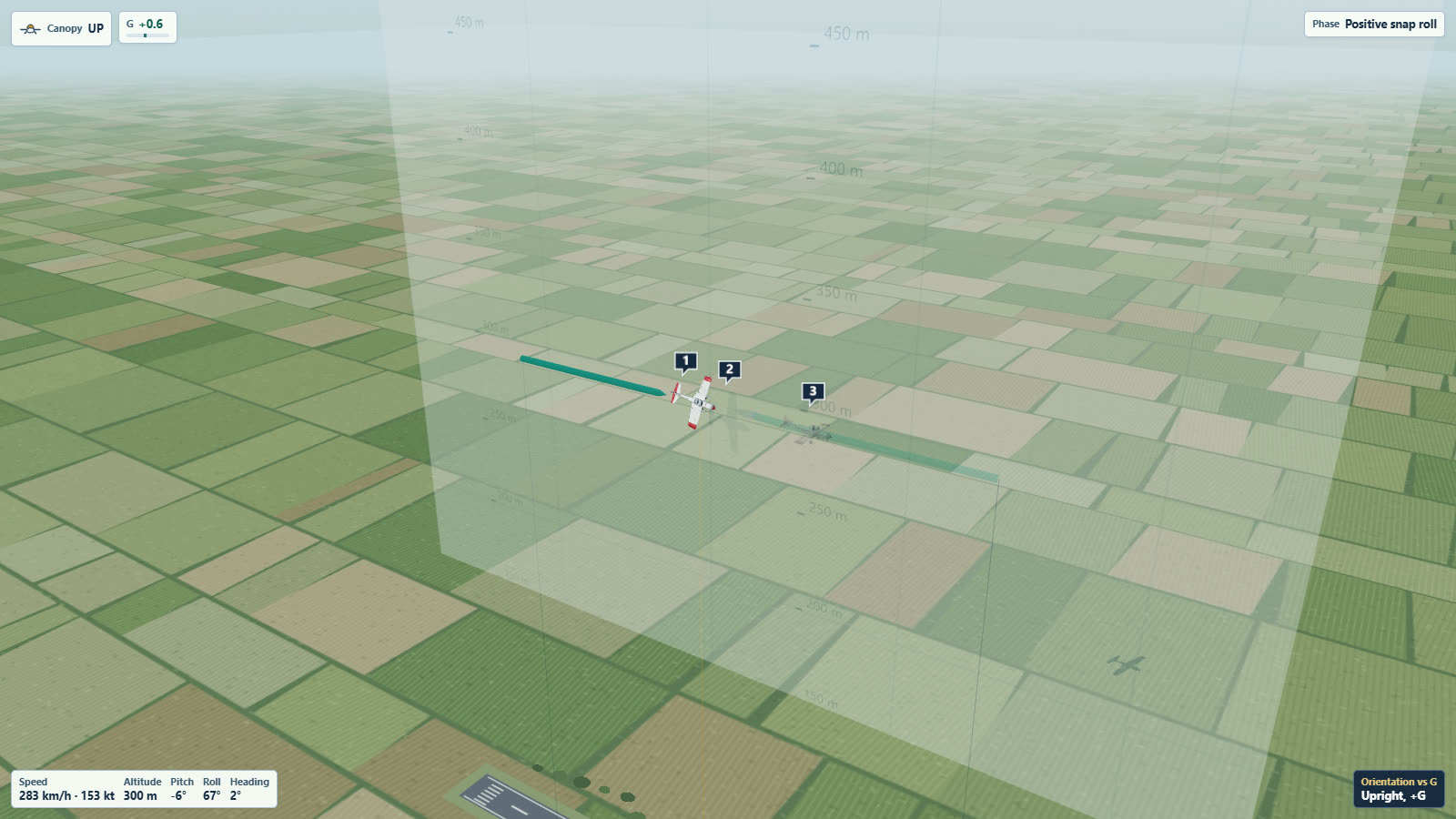
An inside snap roll is a rapid autorotation initiated by an inside, positive-G stall. Unlike a slow roll or an aileron roll, a wing is deliberately stalled, which is what produces the violent, fast rotation.
The pilot pulls sharply to an accelerated stall and applies rudder at the same moment, so the aircraft autorotates like a horizontal spin; opposite rudder and releasing the back pressure stop the rotation on the entry heading. The pilot feels a sharp positive-G spike at the entry followed by a very fast rotation. "Inside" means a positive-G stall entry, even when the snap is flown inside another figure.
What to look for: the entry is a positive-G stall, not a smooth roll input. The rotation is abrupt and fast compared with an aileron roll.
It appears in competition sequences and advanced training, and only in aircraft approved for snap rolls.
Watch the Inside snap roll in 3DSee every figure in 3D
Aerobatics Atlas is a free site that turns aerobatic figures into interactive 3D animations you can watch from any angle. Here is what you can do with it:
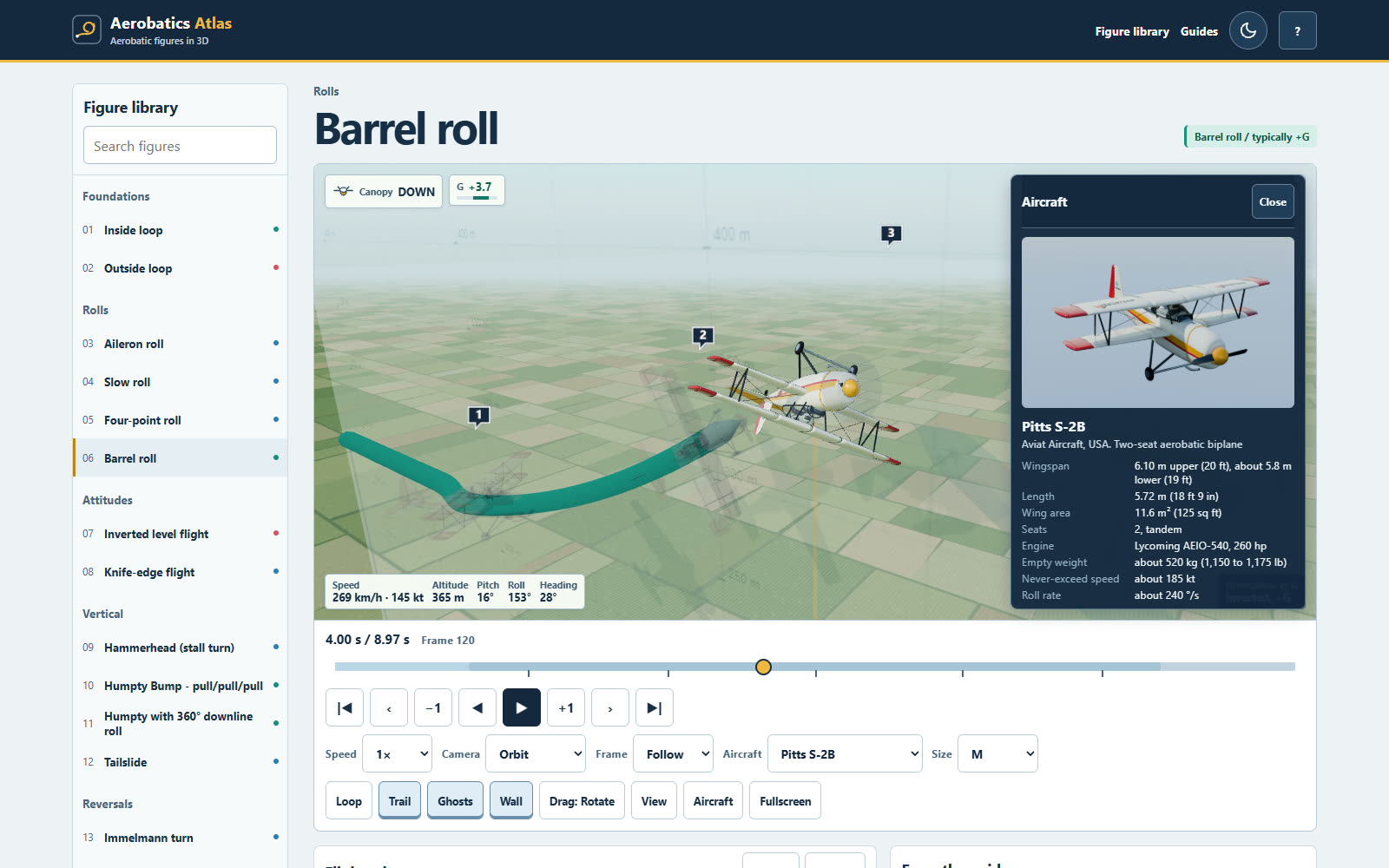
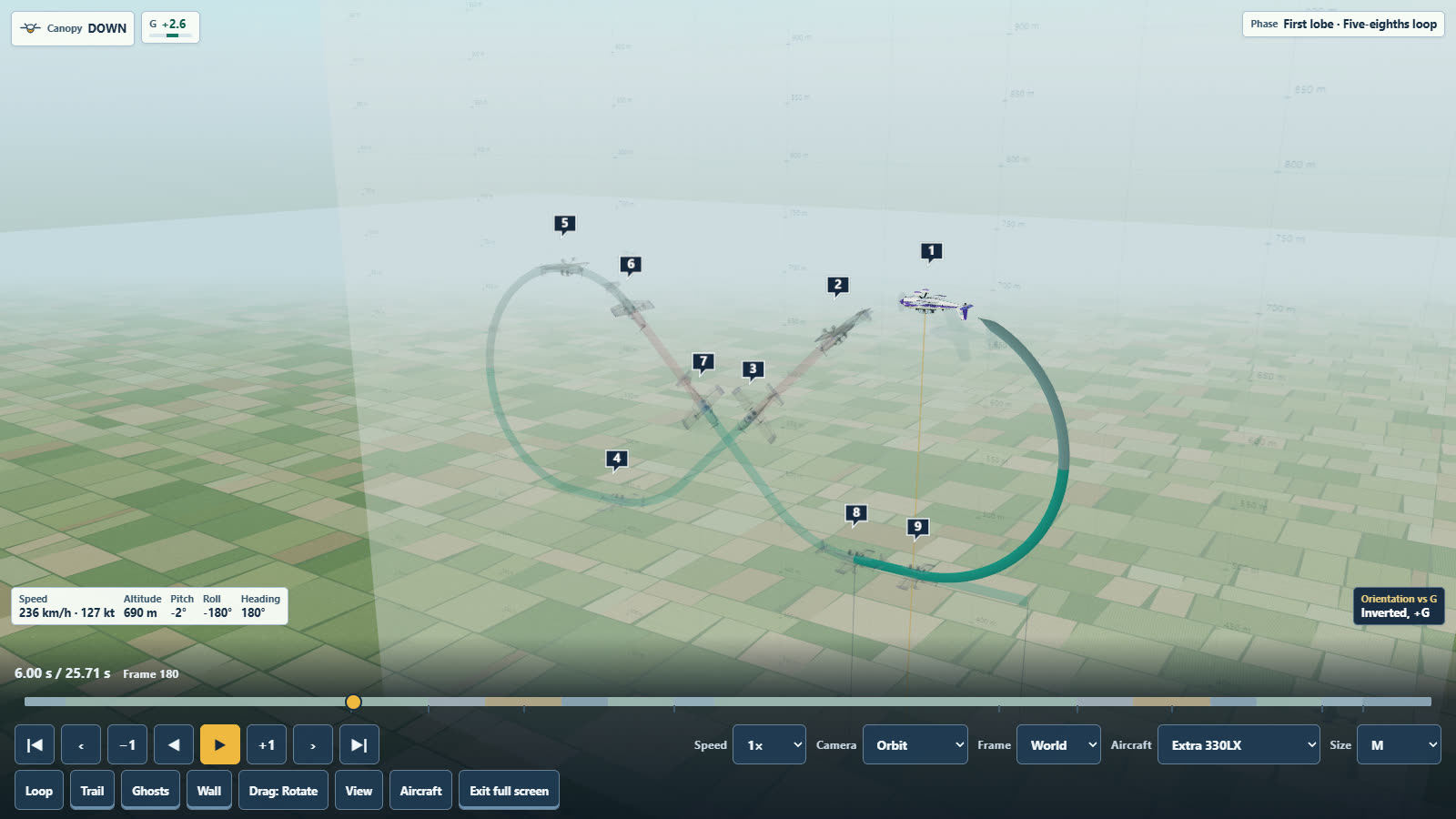
- Explore 45 figures, from foundational loops to advanced snaps and spins.
- Drag with the mouse or use the arrow keys to look from any angle.
- Switch between World, Follow, and Aircraft frames; the Aircraft frame keeps the plane still and rotates the world, which makes roll and pitch obvious.
- Read live G, canopy-up/down, and attitude readouts as the animation plays.
- Play, pause, step frame by frame, and scrub to any moment in the figure.
- Choose from 14 aerobatic aircraft (Extra 330SC, 330LX, 330LT, 330SX, 330LE, Extra 200, Extra 300L, CAP 232, Pitts S-2B, Sukhoi Su-31, Yak-55M, Zivko Edge 540, Zlin Z-50LS, MXS) with sourced specifications, or design your own plane.
- Go full screen with video-player controls for a closer look.